
Circa 2018–2019
"Hey man, is there a raag that fits these notes?"
I has posed the question to "CV" Shankar Venkataraman, my dear friend for over 30 years, and the inspiration for the character "Shekhar" in the story "The Invitation" from my recent book "Bonds").
Our friendship, which started in college, and continued during graduate school, had endured throughout the "grown-up" phases of our middle-aged lives when professional and personal responsibilities held sway over our respective times and energies. And whenever we would meet, a musical hour or two was unfailingly reserved and diligently observed.
I was playing my favorite section of the melody of Maestro Ilayaraja's Ilaya Nila on a guitar.
CV frowned, as he was wont to do when thinking deeply.
"Notes are Amritavarshini," he declared, "although the composition is not."
I looked the raag up. Amritavarshini, as its name (Amrit=nectar; Varsha=shower) implied, was reputedly capable of bringing rain to parched lands. (Just the other day, my mother mentioned that this raag is not usually performed at concerts owing to the risk of weather disruption!)
I was not terribly inspired by the Carnatic renderings on offer on YouTube. However, I quickly learnt that Ilayaraja's Thoongatha Vizhigal Rendu, was based on Amritavarshini. I was intimately familiar with this gem of a composition.
I mentally filed this nugget of information away.
2020
The COVID years, for all the misery that was wrought on humanity, also offered an opportunity for personal, creative growth. In between writing short stories for "Bonds," I started to dabble in music production, partly to recreate the songs and sounds of Sangam, the music band I was a part of while attending graduate school at The Ohio State University.
As most hobbies go, my start was modest, and devoid of financial investments. I found use for an aging TEAC Audio Interface I had purchased for my daughter several years prior, for her to record her singing. Using the free/open-source Audacity software as my Digital Audio Workstation (DAW), I started making covers of popular desi Hindi and Tamil film songs from nostalgic and contemporary eras. In this endeavor, I frequently reached out to several alumni of Sangam to source audio recordings from them—both instrumental and vocal.
After a year, as I hankered to do more, I outgrew Audacity. I switched to Cubase, which I had a free copy of, by virtue of having purchased the aforementioned Audio Interface. I got increasingly ambitious in my musical arrangements, upgraded to a paid version of Cubase, and discovered the amazing world of virtual instruments, MIDI programming and the conveniences offered by a superior DAW.
The Goal (Hope?)
In 2022, after producing many covers of beloved Bollywood songs and chalking up hundreds of miles on my treadmill watching YouTube videos on music scales, melody theory, recording, gain-staging, arranging, mixing, mastering, etc., I felt I should try my hand at creating something original.
YouTuber wisdom on this matter varied. Some camps asserted that the melody always came first while others maintained that the lyrics did, or the groove did, or the chords/progressions did.
I decided that the easiest path for me was to source the lyrics from someone, pick a scale, a few chord progressions, and see what happens.
The Lyrics
Pallavi Garg, my sister-in-law, is a Hindi poet of immense and rising repute. She was kind enough to convert one of her poems into a format/structure that was amenable for a song.
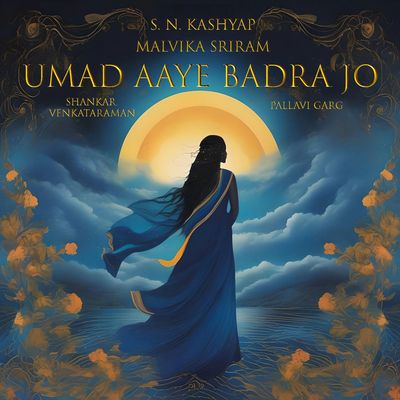
Her brilliant lyrics for Umad Aaye Badra Jo are a vivid portrayal of the arrival of a rainstorm; describing the onset of clouds, the fragrance of the first drops of water striking the earth, and the wind flowing over the narrator's tresses.
I was hooked…and inspired!
The Musical Foundation
Using Amritavarshini as the musical framework was a no-brainer.
The raag is pentatonic--composed of five notes from the Lydian mode (specifically 1-3-4#-5-7) with a simple rule for ascending and descending the scale. I decided to stick to the rules as closely as possible, as I was neither skilled nor confident to violate them.
I picked C as the root note—easy to play the scale on a keyboard as there is only one black key to deal with. (I guess I could have pitch shifted and made them all white keys, heh...)
But Amritavarshini posed a cognitive challenge for my primitive, self-taught musical brain (?).
Primarily, how would I make chord progressions? From the notes of this raag, one gets Cmaj, Emin and pretty much nothing else I liked. Oh sure, I could throw in Cmaj7 here and there but what else? Surely not power chords like C5, E5, B5?
I studied Ilayaraja's Thoongatha Vizhigal. The song cycled between the Major Root and Minor 3rd chords during the vocal melody, and veered off the raag for others.
Western music theory was not much help. There were some vague references to a Lydian Pentatonic scale on YouTube but the content was scant.
Sigh!
The First Version
So, I decided to throw alternate segments of Cmaj and Emin on a chord track, picked a tempo aka BPM (Beats per Minute), plopped in a stock Cubase drum loop and set about noodling on my guitar, waiting for inspiration.
...which eluded me.
I was at an impasse, and decided I needed to do a deeper survey of others' work.
I made playlists of Amritavarshini renditions by artistes on YouTube and Spotify, and tried to unwind the magic behind Thoongatha Vizhigal.
I also asked CV to send me a recording of his Aaalapana (i.e. Alap) of Amritavarshini, and promptly received a superb one.
(I recently set CV’s Alap to music and released it, as Umad Aaye Amritavarshini Alap but that is a story for another blog!)
I got glimmers of ideas for certain patterns.
Then I thought about the melody structure. There were six distinct lyrical lines in the Mukhda (Chorus) section of Thoongatha Vizhigal—it's first two lines posed questions by landing on the 7th notes. The third and fourth lines landed on the 3rd notes. The first line was repeated for the fifth. The resolution mechanism was a repeat of the second line, but this time landing on the 8th (root) note.
OK, so I could use a similar structure, but try to be different...ish...plus, everyone says that melodies should be hummable.
Let’s start with something simple!
I laid out the tune for the Mukhda of Umad Aaye to land on the 7th, 8th, 3rd, 1st and 8th notes. Not a great tune, but it was a start.
I kept the two Antara (Verse) sections identical. I simply used the notes of Cmaj7, completely ignoring the #4. First two lines landing on 7th, third on the 5th (hey, why not?), did the tick of repeating the fourth line—first time landing on the 8th and second on the 1st.
Done. Whew, I had something to shop around to others!
The interludes were easier. The lyrics provided several ideas. The first verse asserted that the rain was underway, invigorating the poet as well as the fauna around. So, music preceding had to describe the onset of the storm, right? The twin guitar leads (played on my cherished Fender Strat) came into being. The higher pitch one heralding the showers, and the lower one signifying the rumble of thunder. The second verse celebrated the poet getting drenched, with warm breezes comforting the mind and body.
I added a stock bass guitar track that just followed the chords, some guitar fillers/licks, cranked out a mixdown, and sent it to Pallavi and CV.
Pallavi was very positive and encouraging.
CV was not terribly impressed.
"It reminds me of Thoongatha Vizhigal, da ..."
"Well, it is the same raag..."
"Let me work on it."
CV explains: "Amritavarshini was an obvious choice considering the lyrics, but is a tough raag to tune in, not many movie songs in it. Plus, I didnt want it to sound like the Ilayaraja famous number in the raag."
The Second Version
That was in July 2022.
Within a month, CV sent me a recording of his take. He had made significant modifications to the melody.
CV recognized that Lines 1 and 2 of the Mukhda (Chorus) section were a query and response; that most of Lines 3 and 4 posed more questions, which the last word Lehraaya answered. In his version of the section, the first line started on the higher root note (8th), and landed on the 3rd note; while the the second line resolved back to the root (8th). The focus on the upper register gave an energy and excitement to the song. Plus, he fixed my crucial mistake: I had connected the second and third lines melodically, which was lyrically incorrect. CV polished off the section with a brilliant Alap which landed on the 7th, arithmetically and harmonically setting up a repeat of Lines 1 and 2.
CV clarifies: "Thoongatha Vizhigal starts from lower Sa (root). So I started this song off at the high Sa and it worked out to energize the melody. The next challenge was Lehraaya. It occupied only half the taal cycle. So I employed a fast taan to complete the taal and lead up to the 1st line. Again this worked out well - the gait/speed change of the taan spiced up the entire song each time Lehraaya repeats."
Genius!
And...my twin guitar leads in the first interlude, which also started on the higher octave, played off the Mukhda perfectly.
CV kept the first Antara (Verse) also around the higher octave, maintaining the energy and excitement. This now provided a contrast to the second interlude's guitar which brought things down to the lower register, and slowly raised and lowered the energy to mirror that of a rainstorm, and the brief respite to come.
CV kept the second verse close to my original tune in the beginning, but mirrored the ascendant scale in the second interlude, setting the stage for an upbeat outro.
In CV's own words: "I kept the first Antara at the high octave to continue the energy of the song. The second Antara's first 2 lines were mostly SNK's. The tune here just hit the spot 👏, I had to tinker just the end to blend to the next line. in fact these 2 lines "nakh se shikh tak bheeg raha, garm havaaye sehata tan man" tune wise and lyrics wise create a serene feeling amidst all the energy of the rainfall and the energetic tune to go along with it, till that point in the song. Love the simple meditative tune of these 2 lines."
Whew!
But...
Although CV stuck to the 4/4 time signature and the BPM, the rhythmic feel of the second version was vastly different.
I knew that if I had to do justice to the composition, I needed to pay close attention to how I composed the groove, which needed to have several elements of swing in it.
But the second version of the melody seemed solid in structure and feel.
CV reminisces: For my initial revision, I sent SNK just the mukhda, SNK's reaction: "it's too ghazal-ish man" 😀 Suspected that response, it was too classical! So it was a good challenge to lighten the tune and make it catchy.
Checkpoint
CV had recorded just his vocals to the accompaniment of a metronomic beat on a Jalra (i.e. Manjira).
In December 2022, I played his recording to Pallavi. We were both attending a family event in New Delhi. I immediately sensed her ambivalent feelings. Devoid of musical accompaniment, the tinny sound on my iPhone speaker was not conveying the genius of the composition.
Somewhat chastened, I returned home, and took a hiatus from the whole project, and my writing took precedence.
The Third Version
The early part of 2023 was spent in revising, editing, producing, publishing and promoting my maiden book "Bonds."
After the book release in May, I decided that I needed to get back into music.
I dusted off Cubase, and tried to refamiliarize myself with the user interface, as well as recall all the tricks and tips I had learned over the years.
Later that month, CV happened to be visiting me. He rendered a fantastic vocal track against a rudimentary backing track of a drum loop and a Cmaj chord drone.
Then I got to work. CV's solid vocals were the impetus I needed.
Rain, clouds, storm, wind, ....
I decided that the set of instruments I'd use ought to convey the musical sounds of these elements
A Ghatam and a high-strung Tabla Daya for the percussive pitter-patter of raindrops, and a Santoor as their musical counterpart. A Mridangam that bridged their timbres with those of distant thunderclaps. A Bansuri for the musical wind element. A combination of shakers for the rustling of leaves, etc.
And what of the groove? That took me a while to put together, until I started following this channel. I embraced the trick of using MIDI drum patterns to make grooves for Tabla. I used it on shakers, and to build a simple bass guitar pattern that pretty much stuck to the notes in Cmaj (maybe it was just C5). I also extracted and adapted a couple of additional fill patterns from within sections of Cubase MIDI samples that I mapped to the Ghatam and Mridangam.
Intro? Someone singing and invoking rain, followed by a cloud burst, then the vocals.
Rain drop cadences rising and falling throughout.
Joyous, festive sounds.
Layers and layers and layers of music tracks. Slowly built and refined over the next 6 months (while also trying to promote "Bonds.").
In January 2024, I cranked out a decent Third Version of the mostly complete composition, and sent it to Pallavi.
She loved it, but pointed out that Lehraaye should be Lahraaya!
A prominent part of the melody had been mispronounced!
Yikes!
I now needed to get CV back to my modest recording setup at home, to maybe do a whole new take..?!
The Fourth (& Final) Version
I took a mini break to ponder what to do next.
I then decided that I needed someone with a fresh perspective and musical creativity to give me some feedback/inputs. As I cast my thoughts, they fell on the younger generation. My own kids were “too close” to the project—they had heard all the major (and minor) versions of the composition to date.
It then hit me. How about Malvika Sriram, daughter of Praveena & Sriram our dear friends and Sangam-founder/alums?
But would she be interested? She was blazing her own path in music, while working full-time was a software professional, and attending grad school!
I may never know, but will forever be grateful to whoever/whatever prompted Malvika to say yes, as she literally "completed" Umad Aaye.
And it all went fast. I was able to easily pitch all the music down from C to A per her request. I shipped her a karaoke track, and she sent me back a recording of her vocal track, which frankly blew my mind.
Malvika had made the melody her own. She had embellished the vocal track with grace notes, musical runs, dynamics, and phrasing improvisations. But, most importantly, her voice infused the perfect combination of raw power and soulful optimism to capture the thunder and rain elements.
CV notes in appreciation: "Malvika took it another level to make it even more catchy and smooth sounding. My second version still maintained the Amritavarshini raag. Malvika added the Ri (Flat 2) note to give it a Puriya touch, which greatly enhanced the listenability for the general audience (not necessarily trained in classical!)"
Once I mixed Malvika’s vocals with the music, it was obvious that the song needed very little else. I did make some tweaks. I added some drum fills (to make them more "human") and other percussive elements (payal, tabla and more ghatam). Per my request, CV sent me an Alap in the A scale, which I inserted in the intro section.
Malvika had also observed that the song could use some piano chords and/or arpeggios. The old quandary (i.e. how do I make Amritavarshini chords?), which I had been trying to ignore, had now resurfaced!
But by now, I had picked up a musical trick or two. I just used slash chords/chord inversions. So, I inserted E/C, F#/C, G/C, B/C (and Cmaj7) chords/arpeggios at various spots where it sounded good, and throughout the outro. Subtle, but present.
Mastering (and re-mixing) & Production
I think I can comfortably state that I am reasonably adept at recording, gain-staging and basic mixing, but the nuances of mastering (with mixing adjustments) eludes me. In this respect, I look forward to using AI, which is maturing fast (although it still has not figured out how to deal with compositions that fuse Indian classical styles with world instruments/sounds).
I decided I needed help, and again, reached out to the younger generation.
CV’s son, Pranav, is graduating this Spring with a Bachelor’s degree in music production. I had heard that Pranav was working on releasing his own album of compositions this year. The final semester of college is usually reserved for the senior project, but per CV’s encouragement, I reached out.
And Pranav made time for me!
What followed was an excruciating cycle of compressing, equalizing, re-mixing, exporting mixdowns, listening on multiple devices; while splicing new vocal recordings from Malvika in three places (to correct the aforementioned pronunciation issue).
But we were not converging on the right sound—especially for the vocals.
Malvika came to our rescue. She made time from her busy schedule to process the vocal track on her own, per her liking.
Then Pranav took over. He worked two straight weekends mastering the track, and finally we had a production quality WAV file for release!
Release/Distribution
Releasing/distributing Umad Aaye was laughably simple, thanks to Distrokid.
I had already tested the waters with "Shreya's Theme" (inspired by the story "Sole Mate" from "Bonds").
I just repeated the process.
Summary & Acknowledgments
I am thrilled to introduce "Umad Aaye Badra Jo," a composition that celebrates the arrival of a rainstorm, while blending the soulful melodies of an Indian Raag with the dynamic, symphonic energy of Western music.
This song has been a labor of love, a testament to the power of collaborating with talented people. From its inception to its final form, it has been a journey filled with personal learning, growth, and inspiration!
I am immensely grateful to the talented individuals who contributed their expertise and passion to this project:
Pallavi Garg: for providing the sublime lyrics that ignited the spark of collaborative creativity!
Shankar Venkataraman for infusing my amateurish take on Amrithavarshini for the main/vocal melody with the timeless essence of Carnatic music!
Manisha Nigam for being my unwavering source of feedback, listening to every version, and providing course-correction suggestions throughout!
Sunita Iyengar, Ranga Sampath, Deepthi Suresh for being Beta listeners; and for their insightful critiques and encouragement.
Praveena Varadarajan, Sriram Krishnaswami for believing in the vision and offering their support/guidance.
Pranav Venkataraman for taking time away from college to provide mixing/arrangement feedback, and for working tireless weekends honing the sound and mastering the song to perfection.
And most importantly, to Malvika Sriram — for taking the vocal melody to unforeseen heights of brilliance, both in composition and in a soul-stirring, transcendental vocal rendering; sending me recordings and feedback of the highest quality, all the while juggling graduate school studies and a full-time professional job!
"Umad Aaye Badra Jo" is now available on Spotify, YouTube, Amazon Music, Apple Music, and iTunes. Your support means the world to the team: so please listen, share, and spread the word.
Thank you for being a part of this journey!
Warm regards,
S.N. Kashyap
Explore the Umad Aaye journey